
TL;DR
Many dealerships miss available OEM co-op advertising dollars, not because the funding isn’t there, but because their inventory marketing isn’t aligned with OEM requirements. Focus on four areas to maximize every available dollar: promote eligible inventory, maintain compliant merchandising, maximize digital visibility, and run targeted inventory-driven campaigns.
The Opportunity: OEM Support Is Bigger Than Ever
OEMs are investing more marketing dollars than ever to help dealerships sell vehicles. Through co-op advertising, manufacturer incentives, and model-specific programs, they provide funding to increase vehicle visibility and move inventory. In fact, J.D. Power reported a double-digit year-over-year increase in manufacturer incentive spending in June 2026.
But many dealerships fail to capture the full value of these programs. Missed deadlines, incomplete merchandising, inconsistent promotion, and poorly targeted campaigns can all leave OEM co-op advertising dollars on the table.
The good news? Most of these issues are preventable with the right inventory marketing strategy.
Four Ways Dealers Leave OEM Co-Op Advertising Dollars on the Table
Missing out on OEM co-op advertising dollars isn’t usually the result of one big miss, but rather “death by a thousand paper cuts.” Here are four typical errors that can cost dealers big time.
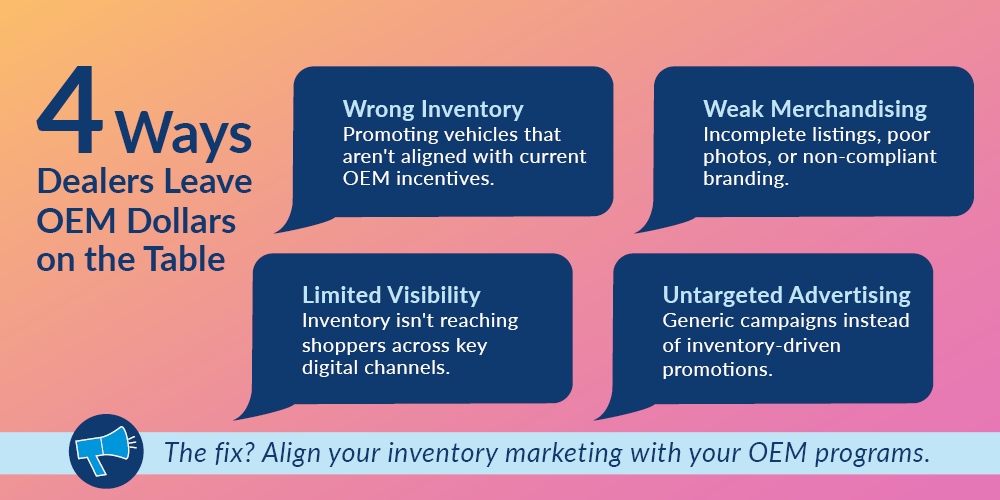
1. Wrong Inventory
OEM incentive programs are often designed to accelerate sales of specific models, trim levels, or aging inventory.
If your advertising isn’t promoting those eligible vehicles, you’re missing an opportunity to maximize both your marketing budget and available OEM funding.
Successful dealerships continuously align their inventory marketing with current OEM programs by identifying eligible inventory, prioritizing those vehicles in digital campaigns, highlighting available incentives, and adjusting promotions as inventory and OEM offers change.
2. Weak Merchandising
Incomplete or inconsistent inventory merchandising can cost you clicks and co-op dollars.
Most OEM programs expect dealerships to stay compliant with accurate vehicle information, professional photography, approved branding, and complete inventory listings.
When these standards aren’t met, your campaigns can underperform, your reimbursement requests can be delayed or denied due to non-compliance, and you might not receive those valuable OEM marketing funds.
Every vehicle should be merchandised as if it’s being evaluated by both a shopper and your OEM, because in reality, it is.
3. Limited Visibility
OEMs invest marketing dollars to increase the visibility of your inventory, but that only works if shoppers can actually find your vehicles online.
Many co-op programs expect inventory to be actively promoted across the digital channels where customers shop, including search engines, vehicle marketplaces, Google Vehicle Listings, social media, and other inventory-driven advertising platforms.
Ask yourself:
- Is our inventory syndicated across the right marketplaces?
- Are our listings optimized for search?
- Are we using inventory-driven Google and Meta campaigns?
- Is our vehicle data accurate across every channel?
If the answer is “no” to any of these, you’re limiting the reach of your marketing and reducing the return on your OEM investment.
Your goal shouldn’t just be to spend co-op funds, but rather to maximize the visibility of every vehicle. A strong inventory marketing strategy ensures your OEM investment is working as hard as possible, putting the right vehicles in front of the right shoppers wherever they shop online.
4. Untargeted Advertising
To maximize the value of your OEM dollars, you put the right vehicles in front of the right shoppers at the right time through your advertising.
Dealers miss out when they take a “peanut butter approach” – spreading budget across broad campaigns without aligning their promotions to inventory, market demand, or customer intent. This kind of non-strategic approach will limit your engagement, deliver fewer qualified leads, and ultimately produce less return from both your advertising budget and your available OEM funding.
Dealers who consistently maximize OEM funding build processes around these programs instead of treating them as occasional opportunities. The most effective inventory marketing strategies pair OEM dollars with:
- High-priority or aging inventory
- Audience targeting based on shopping behavior and intent
- Dynamic inventory ads that automatically feature available vehicles
- Timely messaging tied to incentives, model-year transitions, or seasonal demand
When inventory, targeting, and messaging work together, your OEM dollars go further. Instead of just funding your advertising, they drive qualified traffic, increase vehicle visibility, and improve sales performance. That’s exactly what those co-op programs are designed to support.
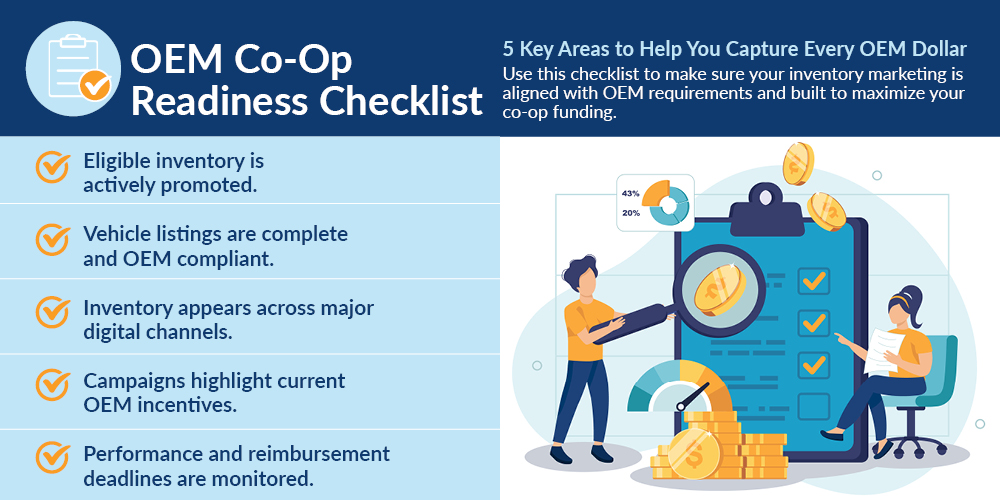
OEM Co-Op Readiness Checklist
- Eligible inventory is actively promoted.
- Vehicle listings are complete and OEM compliant.
- Inventory appears across major digital channels.
- Campaigns highlight current OEM incentives.
- Performance and reimbursement deadlines are monitored.
Treat OEM Programs Like a Strategy, Not a Bonus
Too often, OEM dollars are treated as “extra.” But the most successful dealers treat them as
a core part of their inventory marketing strategy.
That means:
- Prioritizing eligible inventory
- Aligning campaigns with OEM goals
- Ensuring compliance across channels
- Tracking performance and adjusting in real time
When everything is aligned, OEM dollars don’t just support your marketing, they amplify it.
When your inventory marketing is aligned with OEM programs, you see increased visibility for priority vehicles, better use of co-op funds, faster inventory turn and higher ROI on ad spend.
Instead of leaving money on the table, you’re maximizing every dollar available.
Key Takeaways
- OEM co-op programs are designed to increase vehicle visibility and sales.
- Many dealers lose reimbursement because of merchandising, compliance, or campaign execution issues.
- Inventory marketing and OEM marketing should work together—not separately.
- The better your inventory is promoted online, the greater the return on both your advertising budget and your OEM investment.
How AutoSweet Helps You Capture Every Dollar
Managing OEM incentives isn’t just about running ads. Dealers must coordinate inventory feeds, offer management, creative compliance, campaign execution, performance tracking, and reimbursement documentation, often across multiple platforms and changing OEM requirements.
At AutoSweet, we help dealerships turn OEM opportunities into real results.
Our inventory marketing services ensure that:
- Your inventory is aligned with OEM programs
- Listings are fully optimized and compliant
- Vehicles are distributed across the right channels
- Campaigns are built to support priority inventory
AutoSweet’s Offer Management tool helps ensure incentives and promotional messaging remain consistent across your digital marketing channels, making it easier to maintain OEM compliance and simplify the co-op approval process.
That means you’re not just participating in OEM programs, you’re getting the most out of them.
OEM dollars are there to help you sell more vehicles. But only if your marketing is set up to take advantage of them.
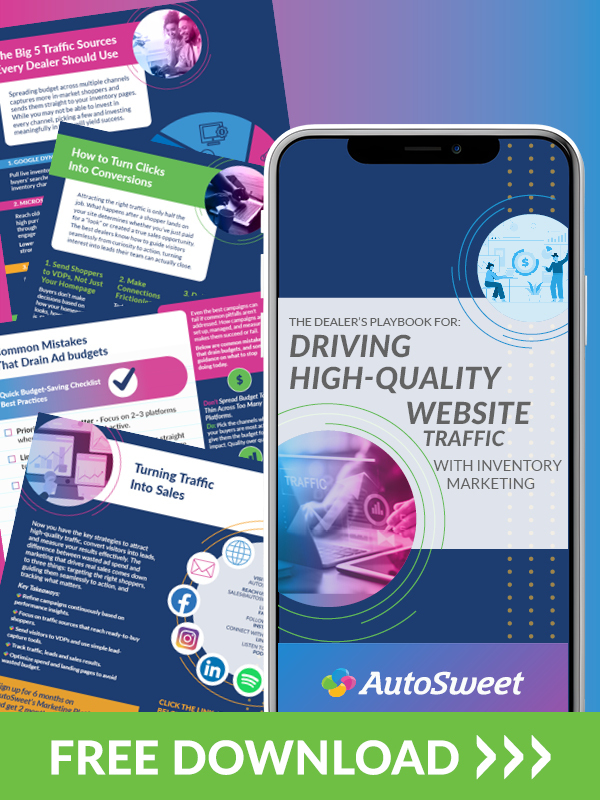
Ready to improve your inventory marketing strategy and capture more available OEM dollars? Download our free ebook, The Dealer’s Playbook for Driving High-Quality Website Traffic with Inventory Marketing, to learn proven strategies for increasing visibility, improving ROI, and making every marketing dollar work harder.
Frequently Asked Questions
What are OEM co-op advertising dollars?
OEM co-op advertising dollars are marketing funds that manufacturers provide to dealerships to help advertise eligible inventory and promotions. Dealers can often receive reimbursement for qualifying advertising that meets OEM program requirements.
Why do dealerships lose OEM co-op dollars?
The most common reasons include promoting the wrong inventory, incomplete vehicle merchandising, non-compliance with OEM requirements, missed reimbursement deadlines, and ineffective campaign execution.
Does inventory merchandising affect OEM co-op eligibility?
Yes. Many OEM programs require accurate vehicle information, approved branding, professional photography, and complete listings. Poor merchandising can impact both campaign performance and reimbursement.
How can dealerships maximize OEM funding?
Dealerships should align advertising with eligible inventory, maintain compliant listings, distribute inventory across key digital channels, and regularly monitor campaign performance and OEM requirements.